Rule 4 of छत्तीसगढ़ शासन भण्डार क्रय नियम, 2002
Tender Procedures & Procurement Methods
Original Text
उप नियम-4.2 निविदा की शर्तों का निर्धारण क्रेता द्वारा किया जाएगा। परन्तु, छत्तीसगढ़ में स्थापित भारत सरकार से मान्यता प्राप्त वैध स्टार्टअप है… को निविदा प्रक्रिया में निम्नानुसार लाभ प्राप्त होंगे :- 1. पूर्व अनुभव की आवश्यकता नहीं होगी। 2. उस पर पूर्व टर्नओवर संबंधी कोई शर्त अधिरोपित नहीं होगी।
उप नियम 4.3.1 एकल निविदा पद्धति… (Proprietary Character)…
उप नियम 4.3.2 सीमित निविदा पद्धति… (50,001 से 3,00,000 तक)…
उप नियम 4.3.3 खुली निविदा पद्धति… (3 लाख से अधिक)…
Visual Summary
Summary
Rule 4 establishes the comprehensive framework for government procurement in Chhattisgarh. It mandates that purchases be primarily conducted through tenders, categorizing them into Single, Limited, and Open tenders based on financial thresholds. The rule integrates modern practices by recognizing GeM (Government e-Marketplace) procedures and providing specific exemptions for local Startups to foster entrepreneurship. It also lays down strict financial safeguards through Earnest Money Deposit (EMD) and Security Deposit requirements.
Key Takeaways
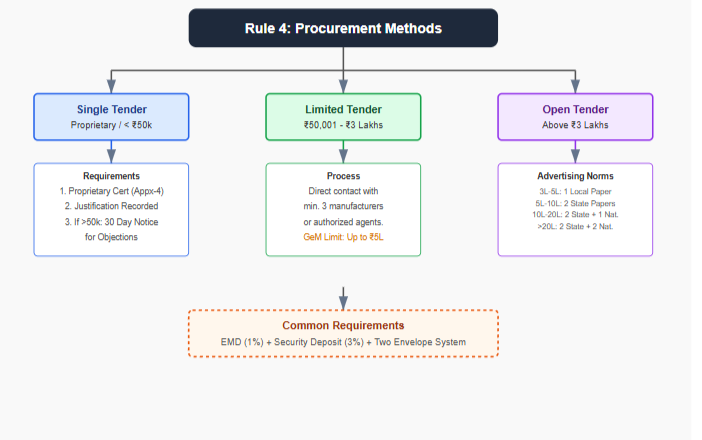
- Thresholds Defined: Purchases up to ₹50k can be single tender; ₹50k-₹3L limited tender; above ₹3L requires open tender with specific advertising norms.
- Two-Envelope System: Mandatory for tenders—one envelope for EMD/Exemption certificate and the second for the actual bid.
- Startup Exemptions: Recognized startups in Chhattisgarh are exempt from ‘Prior Experience’ and ‘Prior Turnover’ conditions and EMD.
- Repeat Orders: Allowed within 6 months of the initial order, up to 25% of the original quantity, provided rates are still valid.
Key Analysis
- ➤ Balancing Efficiency and Transparency: The tiered structure (Single vs. Limited vs. Open) ensures that small purchases aren’t bogged down by bureaucracy, while large expenditures undergo rigorous public scrutiny via newspaper advertisements.
- ➤ Proprietary Safeguards: While single tenders are allowed for proprietary items, the rule introduces a “Challenge Mechanism” requiring a 30-day public notice to invite objections, preventing misuse of the ‘proprietary’ label.
- ➤ Financial Discipline: The explicit requirement for a Purchase Committee (including an Accounts Officer) and the mandatory EMD/Security Deposit creates a check-and-balance system against financial irregularities.
Key Ingredients
- Technical Specifications: Must be determined by experts before inviting tenders.
- Advertisement: Mandatory publication in local/state/national newspapers based on value slabs (>3L, >5L, >10L, >20L).
- EMD (Earnest Money Deposit): 1% of estimated cost (refundable to unsuccessful bidders).
- Security Deposit: Minimum 3% of the contract value from the successful bidder.
- Purchase Committee: Must be constituted for purchases ≥ ₹50,000.
Related Provisions
Practical Illustrations
Process Flowchart
Practice Questions
Q: What is the mandatory percentage for Earnest Money Deposit (EMD) as per Rule 4.7?
- A. 2% of estimated cost
- B. 3% of estimated cost
- C. 1% of estimated cost
- D. 0.5% of estimated cost
View Correct Answer
Reasoning: Sub-rule 4.7(a) explicitly states that to ensure only genuine suppliers participate, 1% EMD must be obtained.
Q: Under Rule 4.3.3, for an Open Tender with a value exceeding ₹20 Lakhs, what is the advertisement requirement?
- A. Two state-level and one national-level newspaper
- B. Two state-level and two national-level newspapers
- C. One local and one state-level newspaper
- D. Only on the department website
View Correct Answer
Reasoning: Sub-rule 4.3.3(a)(4) mandates that for purchases > ₹20 Lakhs, advertisement must be in 2 state-level and 2 national-level newspapers.
Q: What is the maximum limit for a ‘Repeat Order’ under Sub-rule 4.14?
- A. 50% of original quantity within 1 year
- B. 25% of original quantity within 6 months
- C. 100% of original quantity within 3 months
- D. Repeat orders are not permitted
View Correct Answer
Reasoning: Sub-rule 4.14(1) and (3) specify that repeat orders cannot be issued after 6 months and cannot exceed 25% of the original order quantity.
Frequently Asked Questions
Are Startups exempted from EMD?
What happens if a tender is received late?
Can a department buy proprietary items without a tender?
What is the minimum time allowed for submission of Global Tenders?
Conclusion
Rule 4 serves as the backbone of the Chhattisgarh Store Purchase Rules, ensuring that government procurement balances the need for speed with the absolute necessity of transparency. By clearly defining thresholds for Limited and Open tenders, and integrating modern exemptions for Startups and GeM, it creates a structured, auditable, and fair marketplace for government buying.